



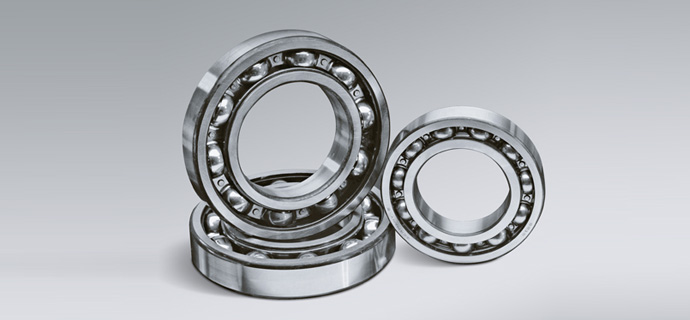
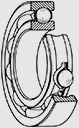
Single-row deep groove ball bearings are a representative type of rolling bearings with wide applications. They can bear not only radial loads but also axial loads in two directions. Featuring low frictional torque, they are suitable for applications requiring high-speed rotation, low noise and low vibration. Apart from open bearings, this type also includes versions equipped with steel dust shields, rubber sealing rings, or snap rings fitted on the outer diameter of the outer ring. Stamped steel cages are generally adopted, while machined cages made of copper alloy are used for large-size deep groove ball bearings and are also applied under high-speed rotation conditions.
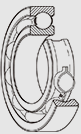
Miniature and instrument ball bearings fall into two basic types: deep groove ball bearings and angular contact ball bearings. According to detailed designs, deep groove ball bearings can be further classified into five categories: standard type, flanged outer ring type, widened inner ring type, extended type with greater radial thickness of the outer or inner ring compared with standard bearings, and thin-section type with thin radial thickness for both inner and outer rings. Deep groove ball bearings can also be divided into open type, shielded type and sealed type based on sealing or dust protection configurations.
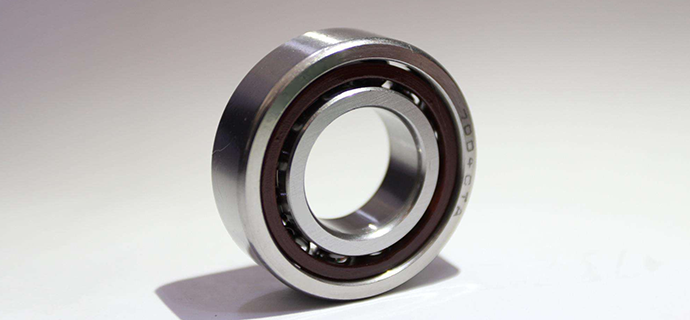
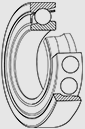
Single row angular contact ball bearings have contact angles and are therefore suitable for bearings axial or composite loads in one direction .In structure, axial separation occurs after bearings radial load. Therefore, two bearings are used in pairs, or more than two bearings are used in a pair. Single-row angular contact ball bearings, which can be preloaded to improve rigidity, are therefore suitable for high-precision machine tool spindles, etc.In general, angular contact Angle bearings retainers with contact angles of 30 degrees (code A) and 40 degrees (code B), according to table 1.However, synthetic resin cage or polyamide cage are also used according to different conditions
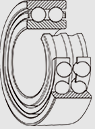
Single row angular contact ball bearings back-to-back double, inner ring, outer ring into a single structure .It can bear axial load in two directions and has torque load capacity. It can be used as fixed end bearings. Use a press cage
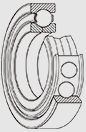
Point contact ball inner ring is divided into two, with a bearings can bear two directions of axial load. Contact Angle of 35 degrees axial load capacity, suitable for the pure axial load, or large axial load composite load .The cage is made of copper alloy
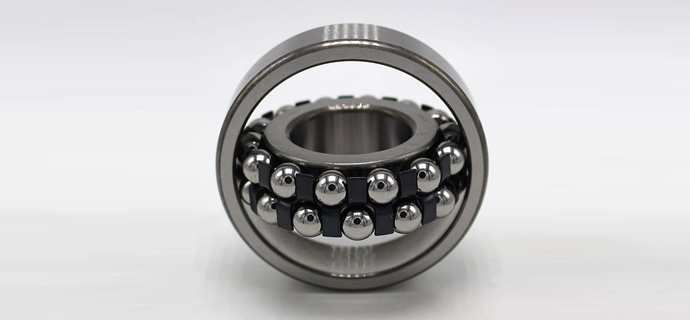

The self-aligning ball bearings is suitable for driving shaft with difficult center and easy deflection of shaft. It Should be small contact Angle, so the axial load capacity is also small, generally used stamping retaining plate. The adjustable Angle allowed for ball bearings under normal load is about 0.07 to 0.12 radians .Depending on the mounting dimensions around the bearings, there are also special cases where this alignment Angle cannot be reached


Thrust ball bearings by single and two - way two types. One-way thrust ball bearings is composed of two rings and a cage with a ball. Bidirectional thrust ball bearings is composed of three rings and two cages with balls. If it is bidirectional, it takes the form of two retainers with a ball clamped on the shaft ring


Long press recognition or screenshot save pay attention
to WeChat public account and get the latest information
